
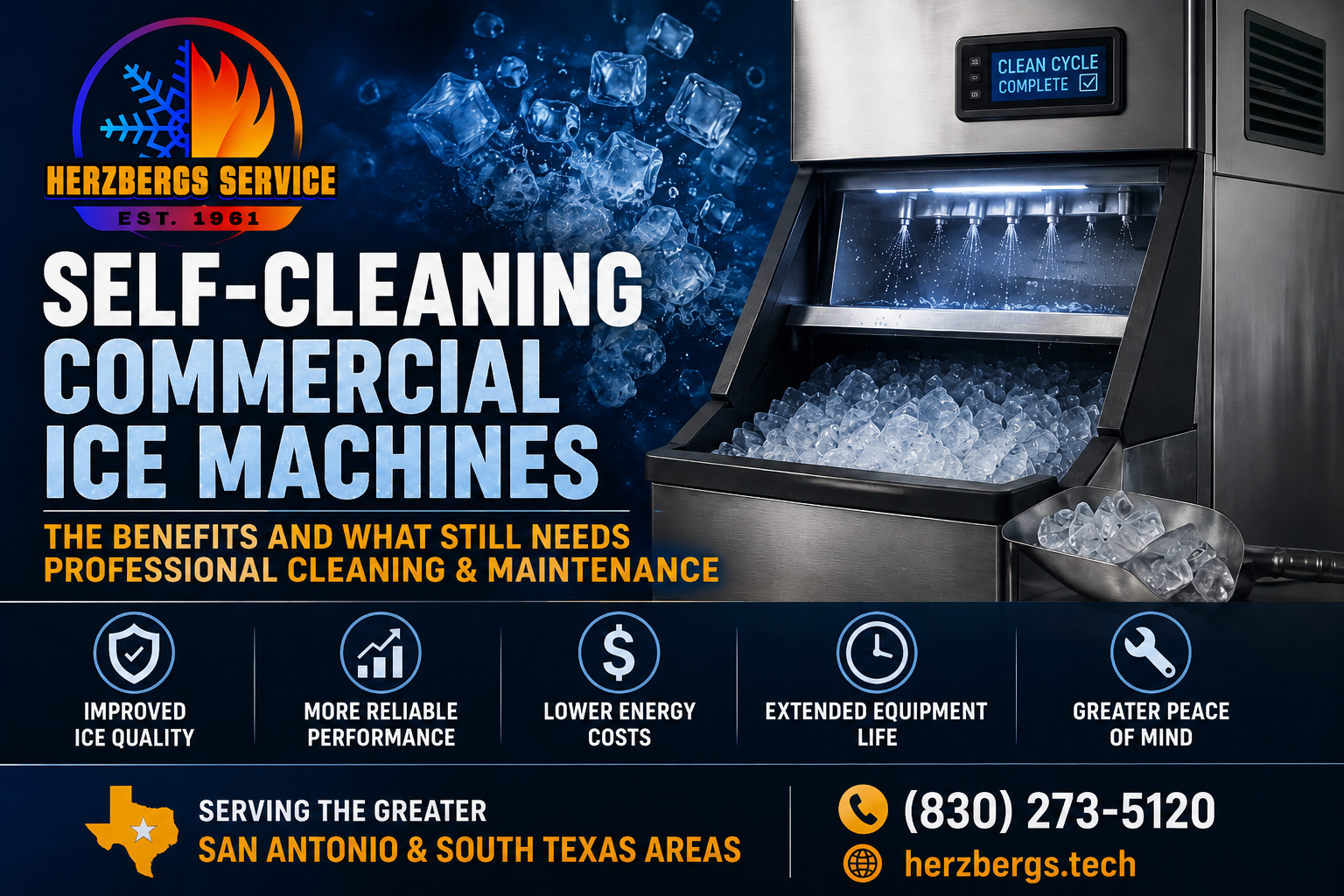
Commercial ice machines are essential equipment for restaurants, hotels, hospitals, convenience stores, schools, event venues, and many other businesses. Because these machines work around the clock using water, refrigeration, and moving mechanical components, keeping them clean is critical for dependable operation and ice quality.
Last month we started our blog with the importance of cleaning ice machines. So, of course we had to follow up with a post about the self-cleaning commercial ice machines. Are they worth it? Do they still need service? We are going to dive into those questions and more! Keep reading to get the inside scoop on these automated ice makers.
Newer commercial ice machines may include automatic rinsing, purging, sanitizing, or “self-cleaning” features. These systems can make routine care easier, but the term self-cleaning can be misleading.
A self-cleaning ice machine is not a maintenance-free ice machine.
Automatic cleaning features can reduce buildup inside certain parts of the water system, but they cannot replace the detailed cleaning, sanitizing, descaling, inspection, and preventive maintenance performed by Herzbergs qualified commercial ice machine technicians.
What Does “Self-Cleaning” Mean on a Commercial Ice Machine?
The exact meaning varies by manufacturer and model. Depending on the equipment, a self-cleaning or automatic cleaning feature may:
- Flush or purge water from part of the system
- Run a programmed cleaning cycle
- Reduce sediment and mineral concentration
- Circulate an approved cleaning or sanitizing solution
- Provide reminders when cleaning is due
- Help limit buildup between scheduled service visits
For example, some commercial models perform brief, automatic purges at regular intervals. These features can help keep the water system cleaner and make maintenance more manageable, but they do not clean every component of the machine.
Business owners should always follow the cleaning and maintenance instructions for their specific make and model. Activating the clean button is only one part of maintaining the equipment.
Benefits of a Self-Cleaning Commercial Ice Machine
Automatic cleaning features provide several valuable benefits for busy commercial facilities.
Reduced Mineral and Sediment Buildup
As water moves through the ice machine, minerals can collect on internal surfaces. Automatic purging replaces some mineral-concentrated water with fresh water, helping slow the accumulation of scale.
This can be especially valuable in facilities where the water supply contains elevated mineral levels. Manufacturers note that high mineral content may require maintenance more frequently than twice per year.
Easier Routine Maintenance
Automated cycles simplify portions of the cleaning process and reduce the amount of manual attention required between professional visits. Built-in reminders can also help employees avoid overlooking scheduled maintenance.
More Consistent Ice Production
A cleaner water system can support more reliable ice production. Mineral deposits, debris, and dirty components may interfere with water flow, ice formation, harvesting, and overall machine efficiency.
Potentially Fewer Unexpected Problems
Regular automatic rinsing may slow certain types of buildup and help prevent minor issues from becoming larger problems. However, this benefit depends on the machine being correctly operated and professionally maintained.
Improved Equipment Care
When automatic cleaning is combined with professional preventive maintenance, it can help protect the machine and support a longer, more dependable service life.
What a Self-Cleaning Ice Machine Does Not Clean
An automatic cleaning cycle cannot visually inspect the machine, remove every component, scrub hard-to-reach surfaces, or identify mechanical problems.
Several important areas still require hands-on cleaning and maintenance by professionally trained technicians.
The Ice Storage Bin
The ice bin is a food-contact area, but it is often separate from the machine’s automatic cleaning system. Moisture, airborne debris, employee handling, contaminated scoops, and repeated opening of the bin can contribute to residue or microbial growth.
The bin liner, door, gasket, scoop holder, baffle, and surrounding surfaces must be physically cleaned and sanitized.
The FDA Food Code states that ice makers and ice bins should be cleaned routinely to prevent slime, mold, soil residue, and the accumulation of microorganisms.
Removable Internal Components
Water curtains, distribution tubes, spray nozzles, troughs, float assemblies, sensors, evaporator surfaces, and other removable parts may need to be taken out and cleaned individually by professionally trained technicians.
Manufacturers’ procedures often require internal parts to be removed for descaling and sanitizing, even when the machine has an automatic sanitation cycle.
Mineral Scale
A rinse cycle may reduce the speed at which scale forms, but it cannot always remove deposits that have already hardened onto internal components.
Our professional descaling uses the appropriate product, concentration, contact time, and procedure for the specific machine. Using the wrong chemical or an incorrect amount can damage metal components, seals, sensors, and other parts.
Mold, Slime and Biofilm
Automatic flushing does not guarantee that every damp surface is reached. Corners, seams, tubing, drains, dispensers, and hidden areas may still develop organic buildup.
These areas often require physical agitation or scrubbing before sanitizing can be effective. Cleaning removes soil and buildup; sanitizing reduces microorganisms after the surface has been properly cleaned. The two processes are related but not interchangeable.
Condenser Coils and Air Filters
The refrigeration side of an air-cooled ice machine is not cleaned by the water-system cleaning cycle.
Grease, dust, lint, and debris can restrict airflow through the condenser. Restricted airflow can make the unit work harder, reduce production, increase energy use, and contribute to overheating or component failure.
Depending on the equipment and operating environment, the condenser and air filter may need cleaning every six months or more frequently.
Water Filters
Commercial ice machine water filters have a limited capacity. Once the filter becomes clogged or exhausted, it may restrict water flow or become less effective at reducing sediment, taste, odor, and scale-forming minerals.
An automatic cycle cannot replace a used filter cartridge. Filters should be inspected and changed according to the manufacturer’s recommendations and the facility’s water conditions.
Drains and Drain Lines
Slow or blocked drains can allow water to back up, create odors, contribute to leaks, or produce unsanitary conditions. Drain lines should be inspected for slime, obstruction, improper routing, and drainage problems.
Mechanical and Refrigeration Components
Self-cleaning features cannot inspect:
- Pumps and motors
- Bearings and augers
- Water valves
- Refrigerant components
- Electrical connections
- Temperature and ice-thickness sensors
- Bin controls
- Fan motors
- Compressors
- Seals and water lines
Our trained technicians can identify wear, leaks, abnormal sounds, low production, and developing failures before they cause a complete shutdown.
What Professional Commercial Ice Machine Maintenance Includes
The exact service depends on the equipment, manufacturer requirements, water quality, and operating environment. Our professional visits may include:
- Discarding existing ice before service
- Disassembling removable internal components
- Descaling the water system and evaporator
- Cleaning and sanitizing food-contact surfaces
- Cleaning the storage bin or dispenser
- Inspecting and cleaning drains
- Cleaning air filters and condenser coils
- Inspecting water filters and replacing them when needed
- Checking water flow and water pressure
- Examining sensors, pumps, valves, fans, and controls
- Checking for water or refrigerant leaks
- Confirming proper freeze and harvest cycles
- Monitoring production and ice quality
- Reassembling and testing the machine
Many manufacturers recommend professional involvement because technicians have the tools, supplies, training, and model-specific knowledge required to perform the work correctly. Failure to disassemble, clean, and treat these components correctly, can lead to costly damage and downtime.
How Often Should a Self-Cleaning Ice Machine Be Professionally Serviced?
There is no universal schedule for every machine. The correct frequency depends on:
- Manufacturer recommendations
- Machine type and model
- Daily ice production
- Water mineral content
- Water filtration
- Kitchen grease and airborne debris
- Ambient temperature
- Facility sanitation practices
- Previous scale or slime problems
Six-month preventive maintenance is common for many commercial ice machines, although some manufacturers specify different intervals. Facilities with high mineral content, heavy usage, grease, dust, heat, or recurring buildup may need more frequent service.
Our professional technicians can help establish a schedule based on the actual condition of your machine rather than relying on a generic timetable.
Warning Signs Your Ice Machine Needs Service
Schedule our professional service when you notice:
- Cloudy, soft, hollow, misshapen, or unusually small ice
- Unpleasant taste or odor
- Black, pink, green, or slimy residue
- Visible mineral deposits
- Reduced ice production
- Longer freeze cycles
- Ice failing to release properly
- Water leaking around the machine
- Unusual noises
- A warm machine compartment
- Frequent cleaning alerts
- The machine repeatedly shutting down
- Dirty condenser fins or clogged filters
Waiting until the machine stops producing ice can lead to emergency repairs, lost inventory, interrupted service, and unhappy customers.
Protect Your Ice Machine with Herzbergs Service
Self-cleaning technology is a helpful feature, but it is not a substitute for professional commercial ice machine cleaning and preventive maintenance.
Herzbergs Service provides commercial ice machine cleaning, maintenance, repair, and installation throughout the greater San Antonio and South Texas areas. Our experienced technicians can service every component of your machine including the water system, bin, condenser, filters, drains, refrigeration components, and other areas an automatic cleaning cycle cannot reach.
Whether your ice machine is producing less ice, showing signs of buildup, or simply due for preventive maintenance, Herzbergs Service can help keep it clean, reliable, and ready for business.
Schedule commercial ice machine service today.
Herzbergs Service
Phone: (830) 273-5120
Contact Us: Click Here
